
Why examine a cat that seems perfectly fine?
Cats do not show tooth pain the way we expect. They keep eating, only chewing on one side, choosing wet food or swallowing kibble whole. The owner sees an empty bowl and assumes all is well, while there may already be a tooth with resorption or periodontitis in the mouth.
On top of that, a conscious cat’s mouth is hard to see. The canines and front teeth are visible, but the large back teeth, the inner surfaces and the back of the mouth are something a cat does not want to show. A regular examination by a vet is a way to spot a problem before your cat starts losing weight or refusing food. Signs worth watching for now are in Signs of tooth pain in cats.
How often: the basic rule and when to come more often
Professional veterinary dental guidelines (WSAVA, AAHA) recommend examining the mouth at every routine visit to the vet — and at least once a year. For a healthy adult cat with no findings, that is usually enough. I recommend more frequent checks when the risk of problems is higher:
I do not tie the exact interval to a breed or a calendar: I set it after the first examination and review it after each one that follows. After treatment for stomatitis, for example, follow-up checks are needed until the lining of the mouth has healed, and then according to plan. For dogs, see How often does a dog need a dental check-up?
Kittens: what to check before their first birthday
A kitten’s first dental check is best done while its teeth are changing — roughly from 4 to 7 months, when the temporary teeth are replaced by permanent ones. Timing and what is normal are covered in Kitten teething. At the examination I check:
- whether a temporary tooth has stayed next to a permanent one — most often a canine;
- the bite: whether the teeth meet correctly and the lower canines do not press into the palate;
- the gums: marked redness, swelling or overgrowth may be juvenile gingivitis;
- teeth broken during play or falls.
It is also a good moment to get your kitten used to having its face touched and its teeth brushed. I explain how to do this without stress in How to brush a cat’s teeth.
What an awake examination shows — and what only anaesthesia reveals
An examination and consultation and an assessment under anaesthesia do not replace each other: they answer different questions.
In cats, X-rays are especially important: some resorption starts on the root, and in the mouth such a tooth looks healthy. More in Tooth resorption in cats and Why pets need dental X-rays.
When an assessment under anaesthesia is needed
I do not book a full dental assessment with radiography “every year just in case”. It is done when the examination and consultation show changes — tartar, inflamed gums, suspected resorption, a broken tooth, red oral lining — or when the cat’s history calls for it. With TR, for example, other teeth can be affected over time, so I plan repeat X-rays individually.
Cleaning without anaesthesia does not replace this assessment: it removes only visible tartar, and everything below the gums stays undiagnosed. That is why the AVDC (American Veterinary Dental College) does not recommend it. Blood tests are needed before anaesthesia, and I order other tests according to your cat’s age and health.
An older cat: is it too late to check the teeth?
It is not too late. With age, resorption and periodontitis are found more often in cats, and mouth pain can be one of the reasons a cat loses weight, grooms less or becomes irritable. Age in itself is not a reason to avoid anaesthesia: the risk is judged by health, not by date of birth.
For older cats I recommend not skipping the yearly check-up and combining it with blood tests, so that kidney, thyroid or heart disease is spotted in time — these affect the treatment plan. More in Anaesthesia for an older dog or cat.
Between check-ups: a monthly look at home
Once a month, take a calm look inside your cat’s mouth. There is no need to open it: when your cat is relaxed, gently lift the lip at the side for a few seconds — first one side, then the other — and use your phone’s torch. If your cat resists, stop and try another time: a few photos are more useful than a struggle.
The diagram below is drawn on a dog’s skull, but the zones are the same in a cat. In addition, look on each tooth at the gum line for a red “bump” or a dip — this is how resorption can look. A step-by-step checklist is in How to check your pet’s mouth at home.
Do not wait for the next planned check if you notice bleeding gums, a broken tooth, swelling or drooling, or your cat starts eating differently. What to do about bleeding gums is covered in Why are my cat’s gums bleeding?
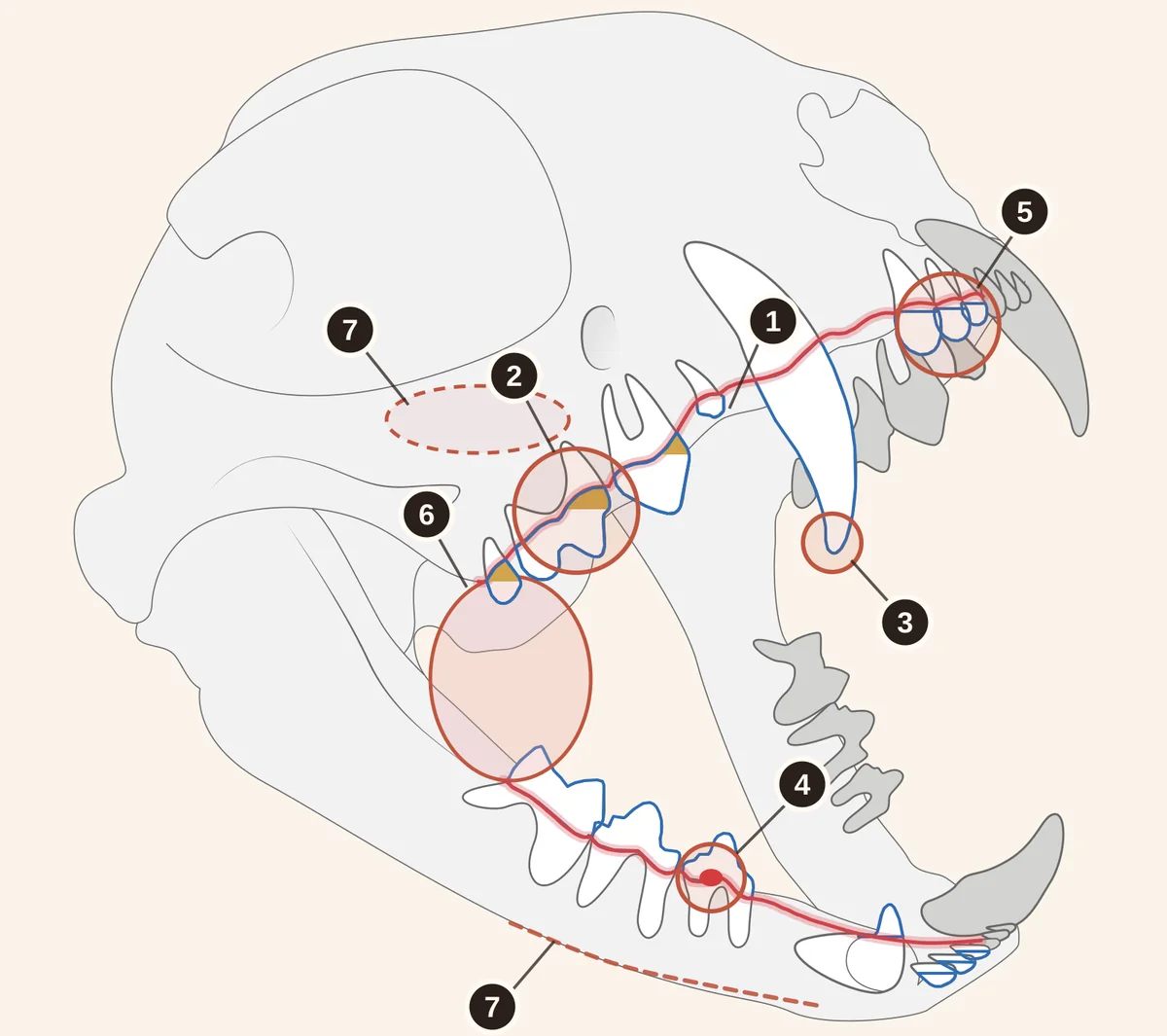
- The gum line. Pink with an even edge. A red line along the teeth, swelling or blood is a reason for a check-up.
- Plaque and tartar at the gum line. Yellow-brown deposits collect most on the big upper cheek teeth.
- Canine tips. Chips, cracks, a pink or dark dot where a tooth has broken.
- A red “bump” at the gum line. The gum seems to creep over the tooth, or a red dot shows at the tooth’s neck — this can be tooth resorption (TR).
- Incisors. Are they all there, and are any loose?
- Back of the mouth, cheeks, tongue. Redness near the last teeth and at the corners of the mouth, ulcers, growths.
- Face and jaws. Swelling under the eye or on the chin, asymmetry, pain on touch.
How much a routine check-up costs
A routine check-up is an examination and consultation. If it shows changes, I explain exactly what is needed and give an estimate for diagnosis under anaesthesia in advance. If you are not in Kyiv, you can start with an online consultation using photos.
When to see a vet
- Your cat has not eaten for more than a day, cries out while eating or the face has suddenly swollen — seek help the same day, without waiting for a planned check.
- Blood on the gums, in the saliva or on food.
- A broken tooth or a tooth that has changed colour.
- Your cat chews on one side, drops food or swallows kibble whole.
- Persistent bad breath, drooling, pawing at the face.
- A kitten: a temporary tooth has not fallen out next to the permanent one, or the gums are bright red.
- A year has passed since the last check, or a follow-up after treatment is due.
What you can do at home
- Once a month, look in the mouth: lift the lip at the side for a few seconds in good light.
- Photograph anything suspicious: photos help to compare changes and prepare for the appointment.
- Brush the teeth daily with a veterinary toothpaste if your cat allows it; build up gradually, with praise.
- Keep a note of check-up and treatment dates — it makes it easier not to miss a follow-up.
- Use products with the VOHC seal as an addition to the toothbrush, not instead of it.
What not to do at home
- Do not put off a check-up because “the cat eats well”: cats hide pain.
- Do not force your cat’s mouth open — it is easy to frighten your cat and get scratched.
- Do not replace an examination with cleaning without anaesthesia: it does not show what is below the gums.
- Do not use human toothpaste: cats swallow it.
- Do not give your cat human painkillers: paracetamol is especially toxic to cats.
Frequently asked questions
Yes. Neither lifestyle nor diet protects against tooth resorption, and plaque forms on any food. A yearly check-up is needed for cats that never go outside, too.
A general examination by your vet is useful, and the mouth is looked at too. But if there is bad breath, tartar, red gums or your cat eats differently, a consultation with a veterinary dentist is needed, and often an assessment under anaesthesia with X-rays.
First while the teeth are changing, at roughly 4 to 7 months, to check the temporary teeth, bite and gums. After that, at least once a year, and more often if the vet sees risk factors.
Not necessarily. Diagnosis and cleaning under anaesthesia are booked when the examination shows changes, or when the cat already has resorption, stomatitis or periodontitis that needs monitoring. For some cats with good home care, a yearly examination and consultation is enough.
No. Age is not a disease, and the risk of anaesthesia is judged by tests. Resorption and periodontitis are found more often in older cats, and treatment can noticeably improve how they feel.
It is individual. Resorption can appear on other teeth over time, so I plan repeat dental X-rays based on what the previous ones showed and on your cat’s health.
No. Brushing reduces plaque and protects the gums, but it does not prevent resorption or show what is happening below the gums. It complements check-ups rather than replacing them.
Sources and professional guidelines
- WSAVA Global Dental GuidelinesGlobal guidelines on veterinary dentistry
- 2019 AAHA Dental Care Guidelines for Dogs and CatsClinical guidelines on dental care
- AVDC Position Statement on Anesthesia-Free DentistryPosition on dentistry without anaesthesia
- AVDC Position Statement on Full-Mouth Dental RadiographsPosition on full-mouth dental radiography
- AVDC: Tooth ResorptionClassification of tooth resorption (TR) by stage and type
© dr.vetstomat. Original content.
Copying and publishing text and visual materials without the author's written consent is not permitted, except as allowed by law.