
Why cats don't show that their teeth hurt
Cats do not complain the way we expect. For an animal that can itself become prey in the wild, showing weakness is a disadvantage, so a cat bears pain quietly. Dental pain also usually builds up gradually, and the cat has time to adapt: it eats more carefully, picks softer food and bites with the healthy side.
Hunger is stronger than discomfort, so the bowl is often emptied as usual. That is why owners put off a visit: “if it hurt, he wouldn't eat”. In fact, a normal appetite does not rule out pain — there is a separate article on this: why pets keep eating with painful teeth.
Every tooth in a cat’s mouth has a pulp with a nerve, so a broken or diseased tooth really hurts. I show how the nerves reach each tooth on a diagram in How a dog’s and cat’s mouth works.
How to tell if your cat's teeth hurt: the signs
Below is a checklist. Each sign on its own can have other causes, but if you see two or three at once, or they last longer than a few days, the mouth should be examined.
Signs that deserve special attention
Eating on one side is a typical sign of pain on one side of the mouth; it is covered in detail in the article why does my cat only eat on one side. If food keeps falling out of the mouth, see the symptom page dropping food from the mouth.
Grooming less is a subtle but telling sign: to groom, a cat has to work its tongue and jaws actively. More in the article why is my cat grooming less.
The most obvious signal is when it is painful to eat: the cat comes to the bowl, tries and walks away, or meows or cries while eating. This should not wait.
How to check your cat's mouth gently at home
If your cat is calm, you can look at the teeth yourself. Do it in daylight or with a phone torch and without restraining the cat: simply lift the lip at the side without opening the mouth. Look for:
- a red line along the gum margin;
- gum tissue that seems to creep onto the tooth, or a hollow in the tooth at the gum line;
- a broken tooth, especially a canine, or a tooth that has changed colour;
- tartar, loose teeth, “stumps” where teeth used to be;
- ulcers or bright red mucosa at the back of the mouth, swelling.
If you see nothing, that does not mean the teeth are healthy. Some lesions hide under the gum or on the side teeth, which are hard to see in a conscious cat. If your cat resists, stop: a few calm photos are more useful than a struggle and scratches.
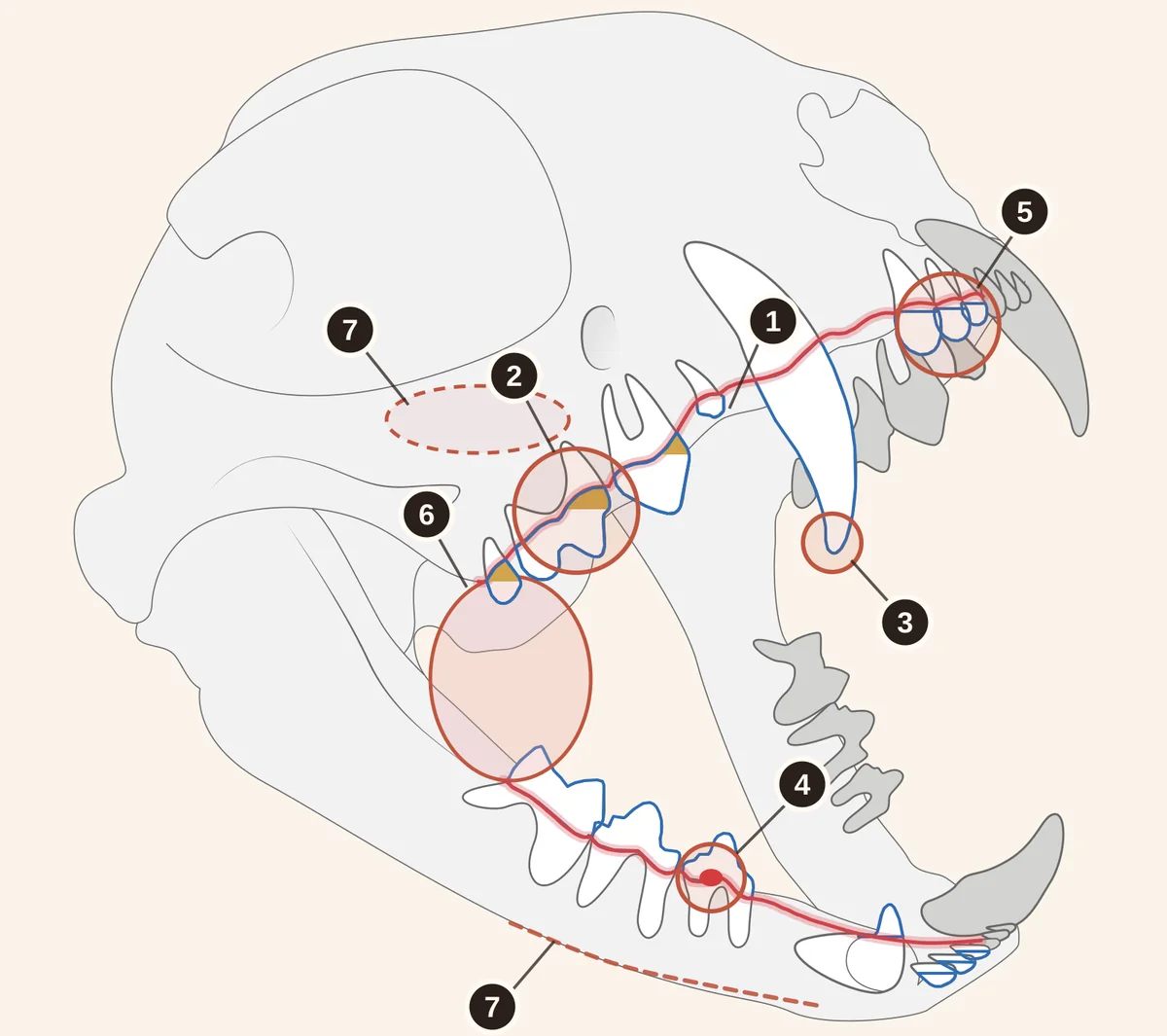
- The gum line. Pink with an even edge. A red line along the teeth, swelling or blood is a reason for a check-up.
- Plaque and tartar at the gum line. Yellow-brown deposits collect most on the big upper cheek teeth.
- Canine tips. Chips, cracks, a pink or dark dot where a tooth has broken.
- A red “bump” at the gum line. The gum seems to creep over the tooth, or a red dot shows at the tooth’s neck — this can be tooth resorption (TR).
- Incisors. Are they all there, and are any loose?
- Back of the mouth, cheeks, tongue. Redness near the last teeth and at the corners of the mouth, ulcers, growths.
- Face and jaws. Swelling under the eye or on the chin, asymmetry, pain on touch.
Why a cat's teeth hurt: the most common causes
Several causes can occur in the same cat, so the vet assesses the whole mouth, not just one “suspicious” tooth.
Tooth resorption (TR)
Tooth resorption (TR) is the destruction of the hard tissues of a tooth by the body's own cells. While the lesion is hidden under the gum, it may not hurt. Once the defect opens into the mouth, the tooth becomes painful: the cat may chatter its jaw when the affected spot is touched, or suddenly drop its food.
TR is not limited to cats — it is also described in dogs — but in cats it is one of the most common dental problems. From the outside it is easily mistaken for a “hole” or a cavity. More in the article on tooth resorption in cats (TR).
- TR 1–2A defect at the gum lineA small pit where tooth meets gum, with red gum tissue growing into it. It may already hurt.
- TR 3The defect reaches the pulpThe tooth hurts, especially when touched or while eating, even if it looks almost intact.
- TR 4The crown breaks downThe crown weakens and may break off. What happens to the root depends on the resorption type, which only an X-ray shows.
- TR 5The crown is goneGum covers the root and the tooth seems to have “fallen out”. Root remnants show only on a radiograph.
Periodontal disease
Periodontal disease is inflammation of the tissues that hold the tooth: the gum, ligament and bone. It starts with plaque and gingivitis and over time destroys the bone around the root. Inflamed gums, deep pockets and loose teeth hurt, especially when the cat bites hard food. Tartar is not always visible: the main changes happen under the gum.
Stomatitis (FCGS)
Feline chronic gingivostomatitis (FCGS) is severe inflammation of the oral mucosa that extends beyond the gums — to the cheeks and the back of the mouth. It is a very painful disease: the cat may cry out while eating, drool, refuse food and lose weight. Diagnosis and treatment are covered in the article on stomatitis in cats.
Broken teeth
Cats break teeth in falls, blows and fights; canines are particularly vulnerable. If the fracture exposes the pulp — you can see a pink or dark dot in the centre of the broken surface — the tooth hurts, and over time the pulp dies and becomes infected. Such a tooth will not heal on its own.
For example, in the case of a broken canine in a cat, the cat had lived with a broken canine for more than three years and refused dry food and toys. After treatment the pain was gone and the appetite returned.
Pain can also come from root remnants, abscesses, growths in the mouth or a lodged foreign body. That is why a full examination matters more than searching for one “guilty” tooth.
My cat's teeth hurt: what to do
Here is what you can do today — safely for your cat:
- 01
Give nothing from your medicine cabinet
No paracetamol, no ibuprofen, no other human painkillers. Pain relief for a cat is chosen only by a vet.
- 02
Make eating easier
Offer soft or soaked food at room temperature; put hard treats away for now.
- 03
Record the symptoms
Write down what you noticed and when; take a few photos or a short video of your cat eating.
- 04
Book an examination
An in-clinic consultation, or an online consultation if you are not in Kyiv. The next open slots are shown at the bottom of the page.
- 05
Diagnose and treat the cause
Under anaesthesia: examination of every tooth, probing and dental radiography; then clinically indicated treatment and pain relief.
Can I just give my cat a painkiller?
Pain relief is needed, but it does not treat the cause. A vet can prescribe a cat-safe medicine to make your cat more comfortable until treatment. But a tooth with resorption, an exposed pulp or no bone support will hurt again as soon as the medicine wears off.
Likewise, an antibiotic “just in case” does not solve the problem. Resorption is not an infection, so it has no effect on it, and periodontal inflammation keeps coming back while plaque and tartar remain under the gum. Antibiotics can also mask the symptoms for a while and make diagnosis harder, so they are only prescribed when clinically indicated.
Why diagnosis needs anaesthesia and dental radiographs
At the in-clinic consultation I assess what can be seen without anaesthesia and draw up a plan. But a conscious cat will not let anyone examine every tooth, and probing a painful spot would cause it distress. On top of that, some lesions — root resorption, root remnants, bone loss — are only visible on radiographs.
So the final diagnosis is made under inhalational anaesthesia with monitoring, after tests (blood tests, echocardiography, abdominal ultrasound): examination of every tooth, periodontal probing and full-mouth dental radiography following the COHAT protocol. Treatment — extraction of affected teeth, professional cleaning, pain relief — is usually done under the same anaesthetic.
What changes after treatment
Once the source of pain is removed, many owners notice that their cat is more active, eats more willingly and grooms again. Often only then does it become clear how long the cat had been putting up with pain. Even after several or all teeth are extracted, cats usually adapt well: once healed, they bite off and swallow their food as before.
How much the examination and treatment cost
You can start with an in-clinic or online consultation. The cost of treatment depends on how many teeth are affected and what the diagnostics under anaesthesia reveal.
When to see a vet
- Your cat has not eaten for more than a day, cries out while eating or walks away from the bowl hungry — see a vet the same day.
- Swelling of the face, cheek or under an eye or bleeding from the mouth that does not stop.
- A broken tooth with a pink or dark dot in the centre.
- Heavy drooling, ulcers or bright red mucosa in the mouth.
- For several days your cat has been eating on one side, dropping food or pawing at its mouth.
- Your cat is losing weight or has stopped grooming.
What you can do at home
- Switch to soft or soaked food for now.
- Put away hard treats and toys your cat chews.
- Note how much your cat eats and how it behaves while eating.
- Film a short video of your cat eating — it will be useful at the consultation.
- Give your cat some peace: do not pick it up by force or touch its face if it avoids contact.
What not to do at home
- Do not give paracetamol, ibuprofen, aspirin or other human painkillers — they are dangerous for cats.
- Do not give medicines prescribed for another animal or left over from “last time”.
- Do not start antibiotics without a prescription: they do not relieve pain from resorption or a fracture.
- Do not force the mouth open or try to loosen or pull out a tooth yourself.
- Do not wait until your cat stops eating altogether.
Frequently asked questions
Pain most often shows in changes while eating: the cat eats on one side, drops food, swallows pieces without biting them or jerks its head away. Drooling, bad breath, jaw chattering when the face is touched and grooming less are also warning signs. The appetite may stay normal.
Switch to soft food for now, put hard treats away and book an examination. Do not give your cat human painkillers: paracetamol is toxic to cats, and other medicines must be prescribed by a vet. Tooth pain does not go away on its own, because its cause lies in the tooth or the tissues around it.
Only a medicine prescribed by a vet after an examination. Pain relief will make your cat more comfortable but will not remove the cause — the affected tooth needs to be treated or extracted.
Cats mask pain, and hunger is stronger than discomfort. The cat adapts: it eats more carefully, on the healthy side, and chooses soft food. So a normal appetite does not mean the teeth are healthy.
To find the source of pain, yes: a conscious cat will not allow every tooth to be examined, and some lesions are only visible on dental radiographs. Tests are done before anaesthesia, and the anaesthesia itself is inhalational, with monitoring.
Sources and professional guidelines
- Cornell University — Tooth resorptionOverview of tooth resorption in cats
- Cornell University — Feline chronic gingivostomatitisOverview of feline chronic gingivostomatitis
- WSAVA Global Dental GuidelinesGlobal guidelines for veterinary dentistry
- AAHA Dental Care Guidelines for Dogs and CatsClinical guidelines for dental care
- Merck Veterinary Manual — Toxicoses From Human Analgesics in AnimalsWhy paracetamol and ibuprofen are dangerous for cats
- Niemiec B. A. — Feline Tooth Resorption, Today’s Veterinary Practice, 2012Review of feline tooth resorption: presentation, pain, diagnosis and treatment
© dr.vetstomat. Original content.
Copying and publishing text and visual materials without the author's written consent is not permitted, except as allowed by law.