
Why a dog keeps eating even though its teeth hurt
“If it hurt, she wouldn’t eat.” Because of this belief, dogs often reach a dentist late. Dental pain usually builds up gradually, and the dog has time to adapt: it takes food on the healthy side, picks softer things and chews less. The drive to eat is stronger than discomfort, and dogs are not inclined to whine about chronic pain.
There is also something particular to dogs: many of them swallow kibble almost without biting it in the first place. So an empty bowl says little about the teeth. Far more telling is what happens with toys, chews and anything the dog really has to bite through. More on this in Why pets keep eating with painful teeth.
Tooth pain is real: every tooth has a pulp with a nerve, and the signal travels to the brain. I show how this works on a diagram in How a dog’s and cat’s mouth works.
How to tell if your dog’s teeth hurt: the signs
Each sign on its own can have another cause. But if you see two or three at once, or they last longer than a few days, the mouth should be checked by a vet.
Pay particular attention to swelling on the cheek, under the eye or along the lower jaw: this happens when infection from a tooth root spreads into the bone. In small dogs, sneezing and discharge from one nostril can mean an oronasal fistula — an opening between the mouth and the nose caused by periodontal disease around an upper canine.
What most often hurts in dogs
One dog can have several problems at once, so at the examination I do not look for a single “culprit” — I assess the whole mouth. These are the most common sources of pain.
Broken canines and the big upper cheek tooth
Dogs break teeth on bones, antlers, hooves, hard nylon toys, stones and cage bars, and in knocks and fights. The teeth that suffer most are the canines and the upper fourth premolar — the largest tooth in the upper jaw, which the dog uses to crack hard things (it is also called the carnassial tooth). A slab often breaks off its outer surface: from outside it looks like a small chip, but the fracture line often runs under the gum.
If you see a pink, red or dark dot in the centre of the fracture, that is exposed pulp — the living tissue with nerves and blood vessels inside the tooth. Such a tooth hurts; over time the pulp dies and infection spreads into the bone around the root. The tooth will not heal on its own. More in the articles on pulpitis and what to do if your dog breaks a canine.
Worn teeth can hurt too. Dogs that chew tennis balls or cage bars for hours gradually wear down their crowns, and if a tooth wears faster than the pulp can protect itself with a new layer of dentine (the hard tissue beneath the enamel), the pulp becomes exposed. I explain what to give instead of risky chews in Which bones are safe for dogs and which break teeth.
- NormalLiving pulpInside the tooth is the pulp, with nerves and blood vessels, protected by enamel and dentine.
- FracturePulp exposedA pink or red dot shows in the centre of the break. Bacteria enter the pulp; it becomes inflamed and painful.
- NecrosisThe pulp diesWithout treatment the pulp dies and the tooth may turn grey or dark. The pain may ease, but the infection stays inside.
- ComplicationAbscess at the rootInfection leaves through the root tip into the bone: an abscess, facial swelling or a draining tract. A dental X-ray shows the bone changes, although early on they may not be visible yet.
Periodontal disease, especially in small breeds
Periodontal disease is inflammation of the tissues that hold a tooth in place: the gums, the ligament and the bone. It starts with plaque and gingivitis (inflammation of the gum margin) and then destroys the bone around the root. Inflamed gums, loose teeth, abscesses and deep periodontal pockets — gaps between the tooth and the gum where bacteria collect — all hurt.
In Yorkshire terriers, Chihuahuas, toy poodles, Pomeranians and Maltese the teeth are crowded, temporary teeth often fail to fall out on time, and there is little bone around the roots. So periodontal disease can start early in these dogs and weaken the teeth quickly. Tartar is not always visible: the main changes happen under the gums. More in Periodontal disease in dogs and Teeth in small dog breeds.
- PD0HealthyGums fit tightly around the tooth; bone is at its normal level.
- PD1GingivitisPlaque at the gumline; gums are red and bleed. Bone is intact — this stage is reversible.
- PD2–PD3PeriodontitisA periodontal pocket forms; up to half of the bone support is lost.
- PD4Advanced periodontitisMore than half of the support is lost; roots are exposed and the tooth is loose.
Other sources of pain
Owners do not think of these straight away, but they hurt too:
- Stomatitis. Ulcers on the lining of the cheeks and lips where it touches plaque-covered teeth are very painful and cause strong breath odour. More in Stomatitis in dogs.
- Caries and tooth resorption (TR) — destruction of tooth tissue by bacteria or by the body’s own cells. Dogs get these too; a tooth hurts when the defect reaches the sensitive tissues.
- Stuck objects and injuries. A stick splinter between the teeth or in the palate, or a wound under the tongue: the dog suddenly shakes its head, drools, paws at its face or cannot close its mouth.
- Growths in the mouth. A lump on the gum or palate hurts when the teeth injure it. Only a biopsy — examination of a small piece of tissue — shows what the growth is.
Where to look: breed and age
Any dog can have dental pain, but the typical sources differ:
- Small breeds (Yorkie, Chihuahua, Pomeranian, Russian toy, Maltese): periodontal disease, loose teeth, retained temporary teeth. Watch for bad breath, blood on toys and sneezing.
- Brachycephalic breeds — flat-faced dogs (French bulldog, pug, shih tzu): in a short jaw the teeth are crowded and rotated, food gets trapped between them and plaque builds up quickly.
- Large, active and working dogs: fractured canines and upper fourth premolars from hard objects, fetching sticks and stones and bite work; worn teeth from balls.
- Anxious dogs that chew crates, doors or kennel bars: worn and broken canines and incisors.
- Puppies: while the teeth are changing the gums can be sore, and that passes. But a temporary canine that has not fallen out next to the permanent one, or lower canines pressing into the palate, is a reason for an examination, not for waiting.
- Older dogs: slowing down, sleeping longer and fussiness about food are often put down to age. Sometimes chronic pain from periodontal disease or an old fracture is behind them.
How to check your dog’s mouth safely at home
If your dog is calm, you can look at the teeth yourself. Choose a moment when it is relaxed and use good light or your phone torch. Do not force the mouth open: gently lifting the lip at the side is enough — first one side, then the other. A dog in pain may bite even its owner, so if it growls or pulls away, stop.
If you see nothing, that does not mean the teeth are healthy: some problems hide under the gums and show only on X-rays. A few clear photos are more useful than a long struggle, and you can send them for an online consultation. A step-by-step checklist is in How to check your pet’s mouth at home.
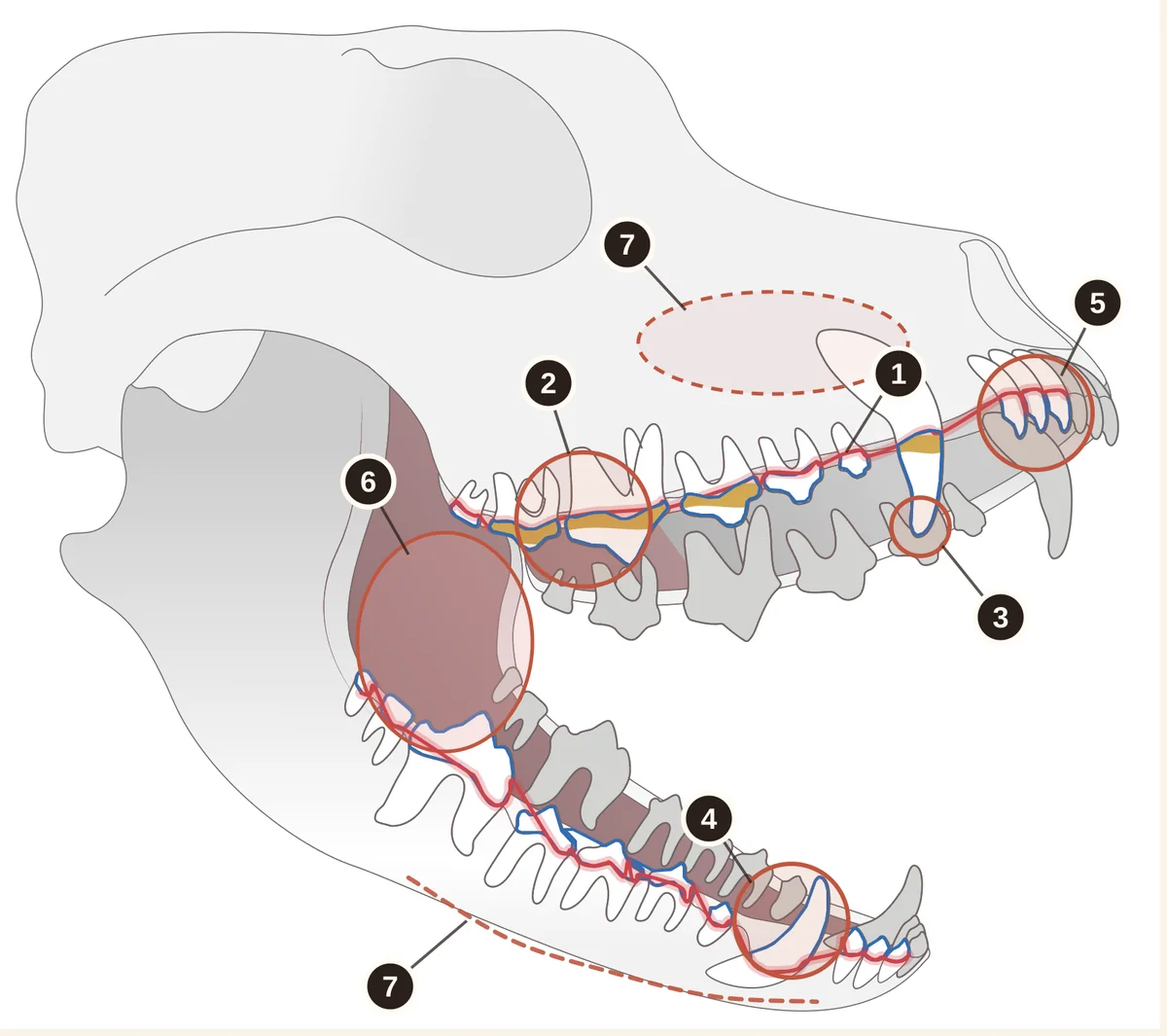
- The gum line. Pink with an even edge. A red line, swelling or blood is a reason for a check-up.
- Plaque and tartar at the gum line. Yellow-brown deposits collect most on the big upper cheek teeth.
- Canine tips and the big upper cheek tooth. Chips, cracks, a pink or dark dot where a tooth has broken.
- Tooth colour. A pink, grey or brown tooth may have a dead pulp.
- Incisors. Are they all there, and are any loose?
- Cheeks, palate and tongue. Ulcers, growths, new dark spots, stuck sticks or bones.
- Face and jaws. Swelling under the eye or along the jaw, asymmetry, pain on touch.
My dog’s teeth hurt: what to do now
Here is what is safe to do today:
- 01
Give nothing from your medicine cabinet
Ibuprofen, naproxen, paracetamol, aspirin and other human painkillers are dangerous for dogs: they can damage the stomach, gut, kidneys or liver. Only a vet should choose pain relief.
- 02
Put hard things away
Temporarily remove bones, antlers, hard treats and toys. Offer softened or soft food at room temperature.
- 03
Record what you see
Note when the changes started; take a few photos of the teeth and a short video of your dog eating and chewing.
- 04
Book an examination
An examination and consultation at the clinic, or an online consultation if you are not in Kyiv. Bring a broken tooth with a pink dot or a swollen face in as soon as possible.
- 05
Diagnosis and treatment of the cause
Under general anaesthesia: examination of every tooth, probing and dental radiography; then treatment as clinically indicated, with local anaesthetic blocks.
How I find the source of the pain
At the examination and consultation I look at the mouth as far as the dog allows, ask exactly how it eats and chews, and draw up a plan. At this stage a broken tooth, inflamed gums or tartar are often already visible. But an awake dog will not let me examine the inner side of every tooth, and probing a painful spot would cause it real distress.
So I make the final diagnosis under general anaesthesia with monitoring, following the COHAT protocol — a comprehensive oral assessment and treatment: examination of every tooth, periodontal probing (measuring the depth of the pockets around each tooth with a fine instrument) and full-mouth dental radiography. Only X-rays show the roots, the bone around them, abscesses and retained roots. Anaesthesia-free cleaning cannot give these answers, and professional guidelines do not recommend it. Treatment — saving the tooth, root canal treatment or extraction — is usually done under the same anaesthetic, once agreed with you.
Sometimes it is only after treatment that owners realise how long their dog had been putting up with pain: it carries its toys again, plays more readily and is keen on treats.
How much an examination and treatment cost
You can start with an examination and consultation or an online consultation. The cost of treatment depends on how many teeth are affected and what the X-rays show, so I give the exact figure after diagnostics.
When to see a vet
- Swelling on the face, under an eye or along the lower jaw, especially if it is growing quickly or the dog is lethargic — the same day.
- Your dog has not eaten for more than a day, cannot close or open its mouth, or bleeding from the mouth will not stop — urgently.
- A tooth has been knocked out, has shifted or is loose after a blow — straight away.
- A broken tooth with a pink, red or dark dot in the centre — as soon as possible, ideally within the first few days.
- For several days your dog has been chewing on one side, dropping toys and hard treats or pawing at its face.
- Persistent bad breath, blood on toys, red gums or loose teeth.
- Sneezing or discharge from one nostril in a small dog.
What you can do at home
- Switch to soft or softened food at room temperature for now.
- Put away bones, antlers, hard treats and toys until a vet has examined the teeth.
- Note what you noticed and when, and film a short video of your dog eating and chewing.
- If your dog allows it, photograph the teeth on both sides, gently lifting the lip.
- If your dog avoids being touched, do not press on its face when stroking it.
What not to do at home
- Do not give ibuprofen, naproxen, paracetamol, aspirin or any other human painkiller — they are dangerous for dogs.
- Do not give medicines “left over from last time” or prescribed for another animal.
- Do not start antibiotics without an examination: they do not treat a broken tooth or periodontal disease.
- Do not force the mouth open and do not try to wiggle, file down or pull out a tooth yourself.
- Do not wait until your dog stops eating: that can take months of pain.
Frequently asked questions
Pain most often shows as changes in chewing and play: the dog drops toys and hard treats, chews on one side, swallows food whole, paws at its face and avoids having its head touched. Bad breath, drooling, blood on toys and facial swelling are also warning signs. Appetite may stay completely normal.
Yes. Dental pain builds up gradually and the dog adapts: it takes food on the healthy side, swallows kibble whole and picks softer food. So a normal appetite rules out neither a broken tooth nor periodontal disease.
Only a medicine prescribed by a vet after an examination. Ibuprofen, naproxen, paracetamol, aspirin and other human painkillers can seriously harm a dog. Pain relief also does not remove the cause: the affected tooth needs treatment or extraction.
It is better not to wait. If there is a pink or dark dot in the centre of the fracture, the pulp is exposed, and the sooner treatment starts, the better the chance of keeping it alive. Dogs usually do not show the pain, while the infection makes its way towards the root.
Sometimes it is age or mood, but it is also a typical sign of dental pain: chewing hard things hurts with a broken tooth or loose teeth. Look at the canines and the big upper cheek teeth, and if the change lasts longer than a few days, book an examination.
While the teeth are changing the gums can be sore and the puppy chews more — this is temporary. But if a temporary tooth has not fallen out when the permanent one has already come through next to it, or the lower canines press into the palate, the puppy needs an examination: these problems are best dealt with in good time.
Some problems are visible at the examination and consultation, but not all. An awake dog will not let every tooth be examined and probed, and the roots and bone show only on dental X-rays, which are taken under general anaesthesia. The dog is checked before the anaesthetic and monitored continuously during it.
Sources and professional guidelines
- WSAVA Global Dental GuidelinesGlobal guidelines on veterinary dentistry
- 2019 AAHA Dental Care Guidelines for Dogs and CatsClinical guidelines on dental care
- AVDC NomenclatureAVDC nomenclature and terminology
- AVDC Position Statement on Full-Mouth Dental RadiographsPosition on full-mouth dental radiography
- AVDC Position Statement on Anesthesia-Free DentistryPosition on dentistry without anaesthesia
© dr.vetstomat. Original content.
Copying and publishing text and visual materials without the author's written consent is not permitted, except as allowed by law.