
COHAT — comprehensive dental diagnostics and treatment for dogs and cats
COHAT is a comprehensive oral assessment under anaesthesia that includes oral cavity sanitation, periodontal examination, full-mouth dental radiography and evaluation of every tooth.
If pathology is found during diagnostics, indicated treatment is carried out according to the plan agreed with the owner. A complete assessment includes examining each tooth, periodontal probing, mobility checks, radiography and documentation of findings.
Interactive
Why “just a cleaning” does not treat teeth
This is a dog’s lower jaw before the procedure: tartar and reddened gums. Try “just cleaning” the teeth — removing the tartar only, as in a cleaning without diagnostics.
This is a simplified drawing for illustration only, not a dental chart or a radiograph of a real patient. Every animal’s findings are different and can only be established during an examination under anaesthesia.
When COHAT may be recommended
- ✓After a dental exam — when there are signs of oral disease or a full assessment of the teeth and periodontal tissues is needed
- ✓Bad breath, plaque or tartar
- ✓Red or bleeding gums
- ✓A fractured or discoloured tooth, or tooth mobility
- ✓Suspected tooth resorption, pain or discomfort while eating
- ✓Planned dental treatment
Symptoms that may indicate this procedure
How COHAT works: all steps
- ✓1. Primary dental examination and consultation (not included in the base COHAT fee and billed separately): history, awake exam, discussion of a possible plan and approximate cost
- ✓2. Anaesthetic support (not included in the base COHAT fee and billed separately): endotracheal intubation, inhalational anaesthesia, continuous monitoring by a veterinary anaesthetist and oversight during recovery from anaesthesia
- ✓3. Comprehensive oral examination under anaesthesia
- ✓4. Plaque cleaning with AirPolishing (Air Flow)
- ✓5. Removal of supragingival and subgingival hard deposits with an ultrasonic scaler
- ✓6. Periodontal examination and assessment of dental hard tissues
- ✓7. Full-mouth dental radiography of all teeth to assess roots, alveolar bone (surrounding bone tissue) and pathology that cannot be detected on clinical examination alone
- ✓8. Tooth-by-tooth assessment and treatment-plan formation
- ✓9. Locoregional anaesthesia: dental nerve blocks with local anaesthetics as part of multimodal pain control during treatment procedures
- ✓10. Necessary dental treatment (not included in the base COHAT fee and billed separately): according to findings and the plan previously agreed with the owner
- ✓11. Follow-up dental radiography after extractions and other treatment procedures
- ✓12. Polishing of tooth surfaces
- ✓13. Dental chart, clinical photos, radiographs, a PDF report and home-care advice
Full-mouth intraoral radiography aligns with AVDC and AAHA guidance: imaging the whole mouth during dental procedures helps assess roots and bone that are not visible on a routine exam.
Additional dental procedures
If full diagnostics reveal pathology that needs treatment, further procedures are done when clinically indicated according to the agreed plan. COHAT includes Treatment, so care is not “outside” the concept — but the specific scope is set only after complete diagnostic information is available.
- ✓Tooth extractions
- ✓Periodontal treatment
- ✓Endodontic treatment
- ✓Tooth restorations
- ✓Crown restoration
- ✓Orthodontic treatment
- ✓Complex surgical interventions and other dental procedures
Why COHAT is done under anaesthesia
A complete dental assessment cannot be done from an awake exam alone. Under anaesthesia every tooth can be examined in detail, periodontal probing and subgingival cleaning performed, and diagnostic dental radiographs obtained. During the procedure the patient is monitored by a veterinary anaesthetist.
More on this: anaesthesia in veterinary dentistry.
Why a consultation exam alone is not enough
At the consultation we can make a preliminary assessment of the mouth and discuss possible treatment options.
The final plan is set after full dental diagnostics under anaesthesia and dental radiography, because some pathology is not visible on a routine exam. Studies cited by AAHA found clinically important radiographic changes even in teeth that looked normal externally: about 28% of such teeth in dogs and 42% in cats.
Technology and equipment
What you receive after the procedure
It gathers diagnostic findings, an assessment of each tooth, procedures performed, clinical photos and dental radiographs. The report stays with you as a clear PDF — you can review, save or share it with another doctor any time.
- ✓Electronic dental chartAssessment of each tooth, its condition and findings at the time of the procedure.
- ✓Clinical photos and dental radiographsPhotos before and after treatment, plus radiographs of the oral cavity.
- ✓Treatment provided and recommendationsA list of procedures performed, home care advice and follow-up timing.
The chart is created in Triadan App
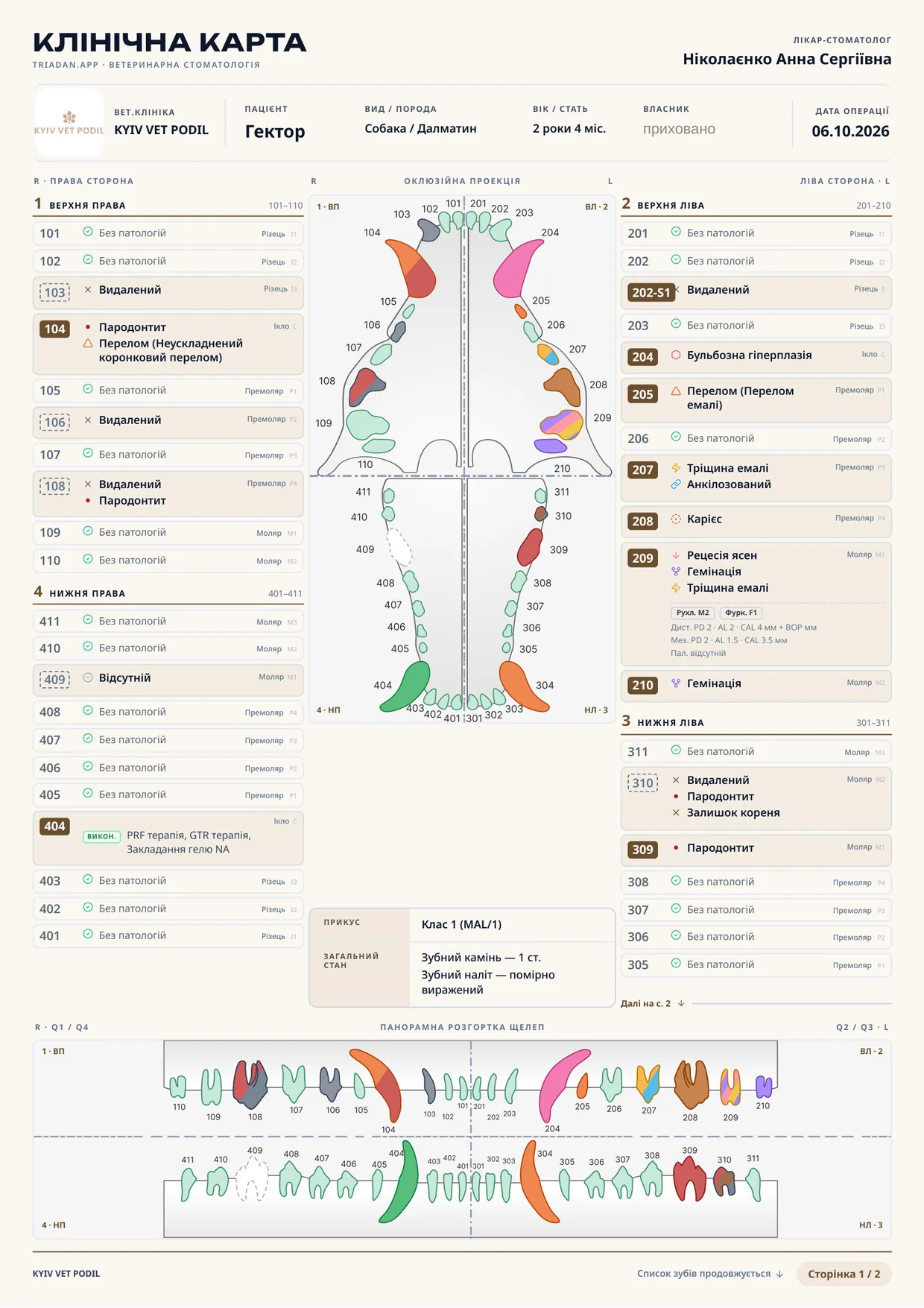
What you receive after COHAT
- ✓An electronic dental chart
- ✓Clinical photographs
- ✓Dental radiographs
- ✓A PDF report with findings
- ✓A record of procedures performed
- ✓Individual home-care advice
- ✓Recommendations for follow-up exams or treatment
Fees
Included in the COHAT price
7 500 ₴ up to 20 kg9 700 ₴ over 20 kg
Everything done during the procedure to clean and diagnose
- Oral examination under anaesthesia: teeth, gums, mucosa, bite
- Ultrasonic tartar removal above and below the gumline
- AirPolishing (Air Flow) to remove soft plaque
- Polishing
- Periodontal examination: pocket probing, tooth mobility
- Dental radiographs of all teeth
- Tooth-by-tooth assessment and a treatment plan
- Local anaesthesia (dental nerve blocks)when treatment is done during the procedure
- Control radiograph after an extraction or other treatment
- Dental chart, photos, radiographs, a PDF report and home-care advice
Required, but billed separately
- Examination and consultation before the procedure, in person or onlinefollow-up consultation — 900 ₴1 250 ₴
- Inhalational anaesthesia with a veterinary anaesthetist and monitoring4 500–5 500 ₴
- Pre-anaesthetic work-up: bloodwork, echocardiography and ultrasoundseparately
Treatment cost — if it is needed
Treatment is part of COHAT, but its cost is calculated separately and depends on the procedures required and their scope.
- At the initial consultation I examine the patient and can outline the likely scope of treatment and its approximate cost.
- What treatment is actually needed can only be determined during full dental diagnostics and dental radiography.
- After diagnostics I explain what needs to be done and why, agree the plan with you — and its cost is added separately to the base COHAT fee.
What may be needed
Related clinical case
Retained teeth in a 5-year-old Chihuahua
Chihuahua · 5 years
View the retained teeth case →Frequently asked questions
The basic fee covers diagnostics and the procedures listed above. Extractions, endodontic, periodontal, restorative and other treatment when indicated are billed separately.
A preliminary plan can be outlined at the consultation. The final scope is set after full diagnostics under anaesthesia and review of the dental radiographs — that is when the full clinical picture is available.
For a complete dental assessment, subgingival cleaning, periodontal examination and dental radiography — yes.
No. Treatment depends on the pathology found and the condition of each tooth. The aim of diagnostics is to choose the most justified option for every tooth.
Related services
Dental Radiography
Full-mouth X-rays reveal roots, bone and changes hidden beneath the gumline.
How dental radiography works →Periodontology & Regenerative Therapy
Oral cavity sanitation, diagnosis and treatment of periodontal disease — from gingivitis to regenerative therapy where indicated.
More about periodontology →Anaesthesia in Veterinary Dentistry
Inhalational anaesthesia with monitoring provides controlled conditions for comprehensive dental diagnostics and treatment.
Anaesthesia safety →© dr.vetstomat. Original content.
Copying and publishing text and visual materials without the author's written consent is not permitted, except as allowed by law.