
What oral papillomas are and why young dogs get them
Oral papillomatosis (many papillomas in the mouth) is caused by the canine papillomavirus. The virus enters tiny breaks in the lining of the mouth and makes its cells overgrow, which is how the warts form. This is a benign process, not a malignant tumour.
Puppies and young dogs are affected most: their immune system has not met the virus yet, and they play with other dogs and chew everything more than adults do. An adult dog may develop papillomas when its immunity is weakened by another illness or by medicines that suppress the immune system. If your dog is on such treatment, do not stop it yourself: discuss the papillomas with the vet who prescribed it.
It takes several weeks from infection to the first visible growths, so your dog may have picked up the virus long before you noticed anything.
- 01
Contact with the virus
The dog picks up the virus from another dog or from objects that dog has had in its mouth.
- 02
Silent period
For several weeks nothing is visible: the virus multiplies in the cells of the oral lining.
- 03
First bumps
Small, smooth, whitish or pink raised spots appear on the lips or gums.
- 04
Growth
The bumps enlarge, become rough and cauliflower-like, and more of them may appear.
- 05
Immune response
Once the body learns to keep the virus in check, in many dogs the papillomas shrink and disappear without treatment.
What papillomas look like and where to look for them
Typical papillomas are several or even dozens of growths: smooth and pale at first, then rough, on a thin stalk or a broader base, greyish-white or pink. They are often compared to cauliflower or a tiny brush.
They are most often noticed on the lips — both inside and along the edge where the lip meets the skin — and on the gums, tongue, palate and cheeks. Sometimes they grow further back, towards the throat, and similar growths can also appear on the eyelids or the skin of the face.
Many dogs ignore their papillomas. But when there are many, you may see drooling, bad breath and traces of blood on toys; the dog eats more carefully or is reluctant to pick up toys. The growths are easily injured by the teeth and during play, so they bleed and can become inflamed.
How to look inside your dog’s mouth calmly without missing anything is covered in How to check your pet’s mouth at home.
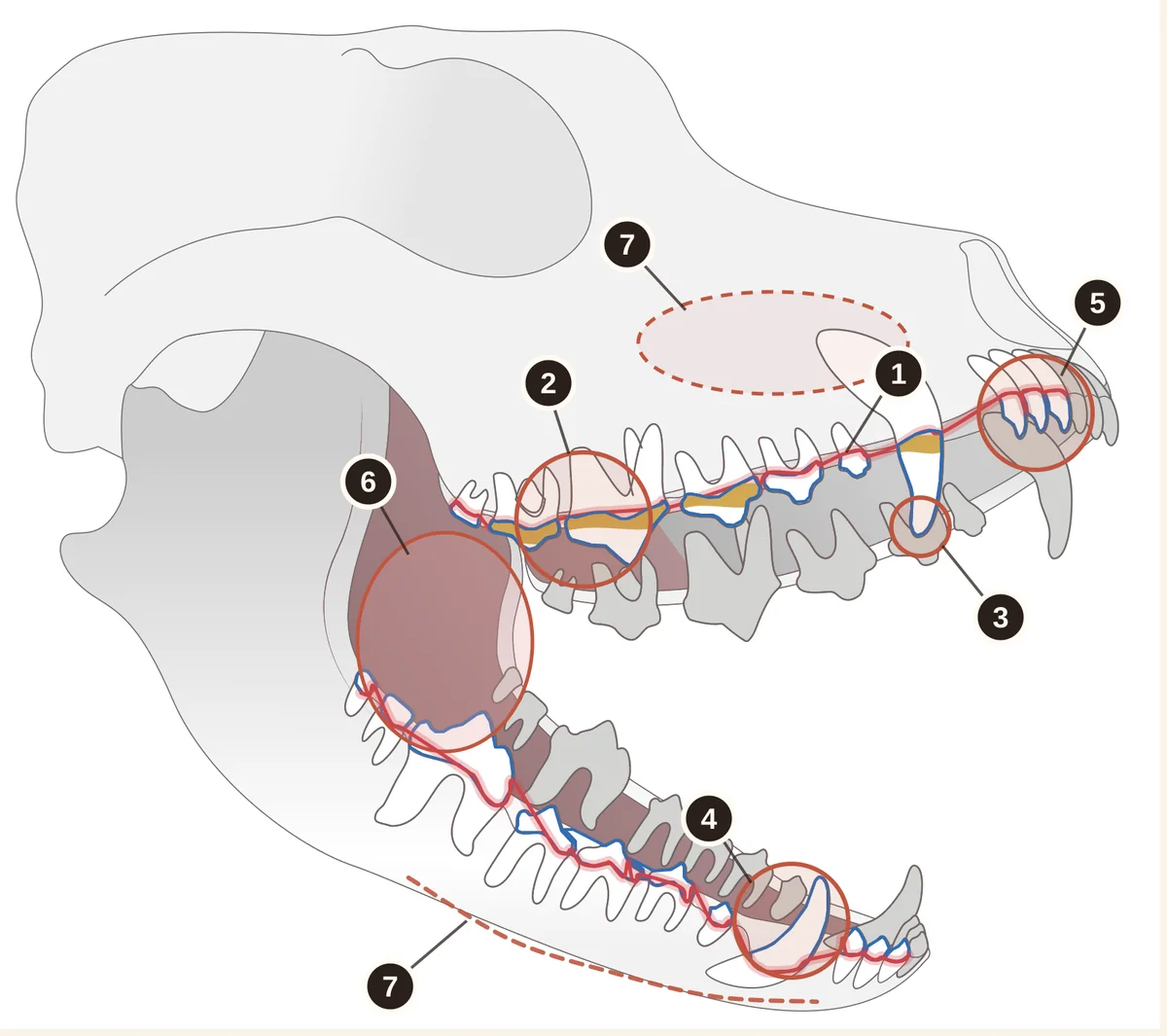
- The gum line. Pink with an even edge. A red line, swelling or blood is a reason for a check-up.
- Plaque and tartar at the gum line. Yellow-brown deposits collect most on the big upper cheek teeth.
- Canine tips and the big upper cheek tooth. Chips, cracks, a pink or dark dot where a tooth has broken.
- Tooth colour. A pink, grey or brown tooth may have a dead pulp.
- Incisors. Are they all there, and are any loose?
- Cheeks, palate and tongue. Ulcers, growths, new dark spots, stuck sticks or bones.
- Face and jaws. Swelling under the eye or along the jaw, asymmetry, pain on touch.
Are papillomas contagious, and how do I protect other dogs?
Yes, papillomas are contagious to other dogs. The virus spreads through direct contact — play, licking, chewing the same stick — and through toys, bowls and bedding, where it can survive for some time. Puppies and dogs with weakened immunity are the most vulnerable.
While your dog has papillomas, I advise:
- not letting it play with other dogs, especially puppies;
- keeping it away from doggy day care, group classes and parks where dogs play together until it recovers;
- not sharing its toys, bowls and sticks with other dogs;
- washing bowls and toys regularly in hot water with detergent, and replacing worn-out toys;
- letting the owners of dogs yours has played with recently know.
On-lead walks without contact with other dogs can carry on. The canine papillomavirus is not considered a risk to people or cats: these viruses are adapted to their own species.
Will papillomas go away on their own?
In many young dogs, yes. Once the immune system “gets to know” the virus, the papillomas stop growing, shrink and disappear. This usually takes anything from a few weeks to a few months. After recovery, a dog is generally no longer susceptible to this virus.
Watching without treatment is reasonable if a vet has examined your dog and confirmed a typical picture: a young dog with a few growths of the characteristic look that do not get in the way of eating. In the meantime I suggest photographing the growths once a week in the same light, next to a ruler, so you can see whether they are getting smaller.
There is no reliable evidence that “immune boosters”, vitamins or home remedies make papillomas go away faster. So I do not recommend giving your dog anything without a vet’s prescription: there may be no benefit, while the risk of side effects remains.
When do papillomas need treatment?
Treatment, or at least a repeat examination, is needed if:
- there are so many papillomas that your dog struggles to eat or swallow, drools or gags;
- the growths bleed, have ulcerated, become inflamed or smell unpleasant;
- they have not shrunk after a few months or keep growing;
- the papillomas have appeared in an adult or older dog, or in a dog with weakened immunity;
- a growth looks atypical: it is single, firm, dark, broad-based, grows from the gum next to a tooth or is enlarging quickly.
Growths that cause problems or look atypical are removed surgically; depending on their number and location, cryotherapy (freezing) or laser is sometimes used. This is done under general anaesthesia with local pain relief — how it is given and monitored is explained on the page on anaesthesia in veterinary dentistry.
I always send the removed tissue for histopathology (examination of a tissue sample under a microscope): it confirms that this is a papilloma and not another kind of growth. Removal takes away the existing warts but not the virus: until the immune system has coped, new ones may appear. So I discuss the plan with each owner individually.
Why an atypical growth should be checked rather than watched
A vet can often diagnose papillomas from the typical picture in a young dog. But other growths can also have a rough, cauliflower-like surface: squamous cell carcinoma (a malignant tumour of the oral lining), an epulis on the gums and, in older dogs, other oral tumours. They cannot be reliably told apart by eye or from a photo — histopathology does that.
Isolated cases have also been described in which long-standing papillomas turned into squamous cell carcinoma. So if a growth has not gone away for months, keeps growing or changes its appearance, I advise testing it rather than continuing to watch.
A smear on its own (cytology — examining individual cells) is often not enough for this decision: I explain how cytology differs from a biopsy in Diagnosing a growth on the gums in a dog or cat. A dark spot or a pigmented growth is a separate story: how to tell natural pigment from melanoma is covered in A dark spot in a dog’s mouth.
What I check at the examination, and where to start
At an in-clinic consultation I check how many growths there are and where, whether there are any further back towards the throat, and whether the teeth are injuring them. Papillomas in young dogs can coincide with teething, so I also check the bite and look for temporary teeth that should already have fallen out — the timings are in When puppies change their teeth.
After the examination I explain whether it is reasonable to watch, when to bring your dog back and whether removal with histopathology is needed. If you are not in Kyiv, start with an online consultation: send photos of the growths and I will tell you how urgently an in-person examination is needed. But a photo replaces neither an examination nor histopathology.
When to see a vet
- You have noticed growths in the mouth for the first time — so a vet can confirm they are papillomas
- Papillomas have appeared in an adult or older dog
- The growths bleed, are ulcerated or smell unpleasant
- Your dog struggles to eat or swallow, drools or gags
- The papillomas have not shrunk after a few months, or there are more of them
- There is a single, firm or dark growth, or one growing from the gum next to a tooth
- Difficulty breathing or refusing food and water — the same day
What you can do at home
- Photograph the growths once a week in the same light, next to a ruler or a coin, and note the date
- Put away hard toys, sticks and tough treats that injure the papillomas for now
- If your dog is eating carefully, offer soft or soaked food
- Keep brushing the teeth, but guide the brush gently around the growths
What not to do at home
- Do not cut, tie off with thread, pull off or burn papillomas: this causes bleeding, pain and infection, and damaged tissue is less suitable for histopathology
- Do not apply greater celandine, iodine, vinegar or human wart treatments: they burn the oral lining, and your dog licks them off
- Do not give “immune boosters”, antivirals or human medicines without a prescription: ibuprofen, paracetamol and other human painkillers are dangerous for dogs
- Do not let your dog play with other dogs until the papillomas have gone
- Do not wait for months if there is a single, firm or dark growth, or one that is growing
Frequently asked questions
The canine papillomavirus is not considered a risk to people or cats: these viruses are adapted to their own species. Other dogs can catch it, so while your dog has papillomas, limit play with other dogs and do not share toys or bowls.
Usually anything from a few weeks to a few months: that is how long the immune system needs to learn to keep the virus in check. If the growths have not shrunk after a few months, there are more of them or your dog struggles to eat, take it back to the vet — that is when removal and histopathology are discussed.
Not necessarily. If a vet has confirmed the typical picture in a young dog, the growths can be watched by photographing them every week. Removal is needed when papillomas get in the way of eating, bleed, do not go away or look atypical.
Yes, on-lead walks can carry on. Avoid play and contact with other dogs, shared bowls, sticks and toys, as well as dog parks and day care, until the papillomas have gone.
Most dogs take no notice of them. But growths that get injured by the teeth or toys bleed, become inflamed and can hurt: the dog eats carefully, drools or refuses hard treats. In that case it is worth taking your dog to the vet.
Yes, for example when immunity is weakened by illness or treatment. But in an adult dog a similar growth is more likely to need a biopsy, because another tumour can hide behind the look of a papilloma. So I advise showing such a growth to a vet rather than waiting for it to go away.
Sources and professional guidelines
- Cornell University — Oral cavity tumorsOverview of oral cavity tumours
- American College of Veterinary Surgeons — Oral TumorsOverview of oral tumours in small animals
- Cornell University — Diagnosis and staging: principles of tumor biopsiesPrinciples of tumour biopsy
- Simões et al. — Cytological and histopathological diagnoses of oral lesions in dogs and cats, 2025Comparison of cytology and histology of oral lesions
- WSAVA Global Dental GuidelinesGlobal guidelines on veterinary dentistry
© dr.vetstomat. Original content.
Copying and publishing text and visual materials without the author's written consent is not permitted, except as allowed by law.